Stones, Donkeys and Other Disciples

A Sermon for Luke 19:28-40 for April 10 2022, Palm Sunday

It is the Sunday before Passover and throngs of people line the streets. The famous rabbi is coming to Jerusalem! The famous rabbi who has healed people, the one who raised Lazarus! (do you think Lazarus was there that day?) The rabbi who has worked wonders throughout the land is coming to town.

It is Palm Sunday for us. A day of celebration and the start of Holy Week. The Palm Sunday story comes to life in the Bible in each of the four Gospels. Jesus rides on a donkey toward the city. Throughout the years our imaginations have been fed with the visions of hordes of people massing along his path waving branches and shouting, Hosanna!  This has been celebrated in art. It has been celebrated in music. I’m old enough to have spent my babysitting money for original Jesus Christ Superstar album, AND to have seen the touring company in the old Auditorium Arena. Thus, this time of year I live with one earworm or another. For me, the season of Lent, Holy Week and Easter isn’t complete if I haven’t listened to Hosanna, hey sanna, sanna sanna ho Sanna hey, sanna ho Superstar.

If I haven’t imagined the Pharisee’s anticipating a riot and instructing Jesus to rebuke his disciples, the common crowd, for being much too loud. And Jesus’s reply… Why waste your breath moaning at the crowd? Nothing can be done to stop the shouting. And besides, even If every tongue was still, the noise would still continue. The rocks and stones themselves would start to sing.

The rocks and stones themselves would start to sing. <pause>

Even the stones will cry out.

Years ago I joined a group of clergy and others on a trip to the Holy Land.  It was billed as “Walking In the Footsteps of Jesus.” We visited Nazareth, Bethlehem, the Sea of Galilee, Jericho and the River Jordan. We spent a full day at the Temple Mount in Jerusalem, and journeyed along that path that Jesus took into the city. Along the ancient retaining wall that surrounds the old city. We made our way to an area called the Western Wall. Once called the Wailing Wall. Since we had arrived at a time for men only to visit the wall, I stood with others and watched while we waited our turn. As I observed those many slips of paper being pressed into the fissures and folds of the ancient wall, I softly spoke these words, “Even the stones will cry out.”

Before visiting Jerusalem, I held the vision of Palm Sunday that I had been taught in Sunday School. The picture in my mind was the one of Jesus on a donkey, making his along the road and down a hill into town. Hearing this scripture, I assumed the stones crying out were those on or along the pathway Jesus was following, along the roadway into the city.  I wonder now, though, if, from his seat on the donkey, Jesus was gazing at the city walls of Jerusalem. If he was looking up at those countless stone blocks making up the walls and buildings … the temple. I wonder if Jesus was seeing the stones, knowing they represented the people, the living souls and those gone, the thousands of workers who had quarried the stones, carved the blocks, carried them on their backs. Carried them to build the city time and again throughout centuries of war and occupation and destruction. Was it these people, the poor of the world, the workers, who, with raucous praises gladly welcomed this Rabbi, that Jesus was speaking of. Those who welcomed him as the king, as the savior they hoped for.

Even the stones will cry out.

Many of the words that have been attributed to Jesus in our sacred texts echo words found in the Hebrew Bible; in the Old Testament scriptures. With these words about stones, Jesus reflects that prophet Habakkuk. Jesus echoes the condemnation of those in power. Condemns those who built cities by bloodshed and injustice. Jesus reflects the words of one we now consider a minor prophet, Habakkuk, “The stones of the wall will cry out, and the beams of the woodwork will echo it.”

The very stones will cry out, Jesus says. 

Jesus entered into Jerusalem to the cries of the people, to shouts of hosanna.

“Hosanna” was the shout of praise or adoration. Hosanna, recognizing the messiahship of Jesus for his triumphal entry into Jerusalem. Sitting on that humble donkey, Jesus knew that his very presence in Jerusalem challenged those in power. Did he know precisely what would happen in the days following? Maybe. He had to have known that pissing off people in power would not be a good thing. But even the stones cried out to him. The stones along the path, the stones of the city walls, the stones of the walls of the temple. Cried out for change, for freedom, for justice. Cried out for a new way of living and being. Cried out for a kingdom not built on the backs of the enslaved. Cried out for a kingdom of quiet wonder and the peace of the divine order.

The Chinese philosopher, poet and politician, Confucius, once said that the one who moves a mountain begins by carrying away small stones.

What are the stones saying today? What are the stones of our time? The stones of the great pyramids of Egypt, of Stonehenge, the Parthenon, Mount Rushmore. The stones that make up the beautiful symbols of the Taj Mahal, the cathedral of Notre Dame, the Tower of Pisa. The great wall of China that can be seen from outer space, the monument to Crazy Horse in South Dakota, the dry, stone walls and huge blocks of the Incan citadel of Machu Picchu. 

Even the stones will cry out.

What is being said by the too numerous stones on the graves of warriors, poets, philosophers, scientists, teachers, what are those saying to us, today? The headstones of soldiers and students, activists and protestors. The stones marking the graves of George Floyd, Breonna Taylor, Philando Castile, Tamir Rice, Michael Brown, Ahmaud Arbery.

Even the stones will cry out.

The sandstone walls of Lake Powell being exposed by drought due to climate change. The stones of the foundations thousands of homes burned in wildfires, or made shambles by the bombs of war.

Jesus rode into Jerusalem on the back of a donkey, maybe knowing that he was in his last week in human form. Certainly, knowing the opposition that lay before him. Yet Jesus heard the stones as they cried out, and he remained undeterred in his mission. He would teach at the temple each day and spend his nights on the Mount of Olives. He would boldly clear out the vendors from the temple portico. Jesus would gather disciples and friends into the upper room for a meal, breaking bread and asking to be ever remembered.  He would be denied, betrayed, arrested, subjected to a trial and multiple punishments and degradations. He, himself, would cry out to God for the cup of suffering to be taken from him. Many in those in the crowds that first day in Jerusalem, many who had hailed Jesus as king on that day we call Palm Sunday, many would be crying out for his crucifixion by Friday.

We are the stones, my friends. We are the ones who must continue to cry out about injustice. We are the disciples who must work — carrying the stones and crying out for those whose voices can no longer be heard or who have limited voices in the world. We are the stones. We are the disciples cheering Jesus today and we must be the stone who rolls away from the opening of the tomb on Easter morning.

Even the stones will cry out.  Amen.
The Wonderful Messiness of Community

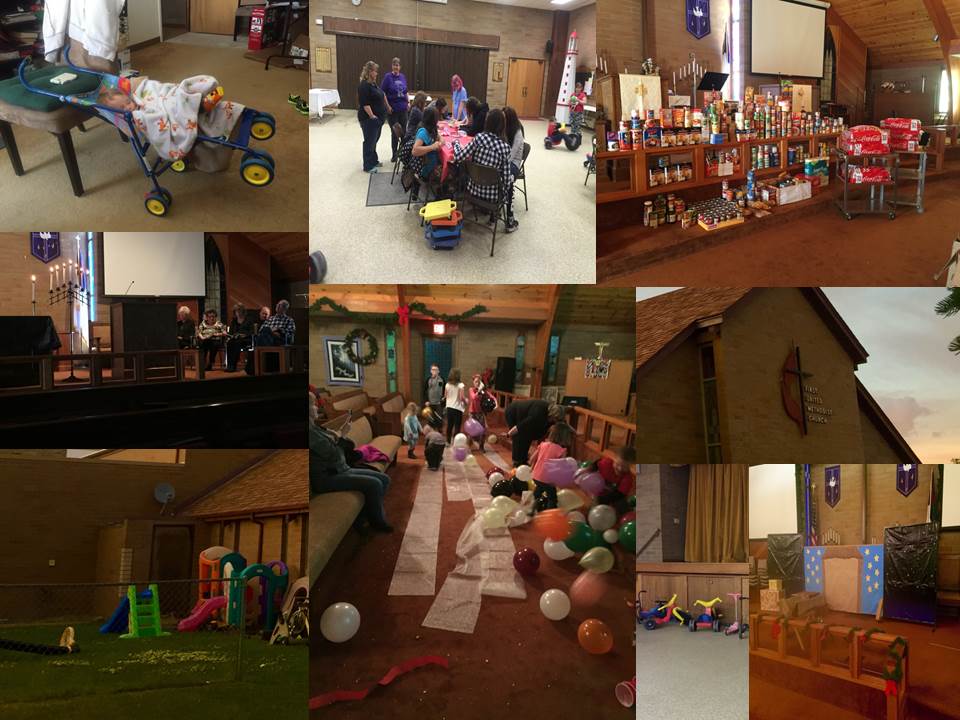
The other day I had to pick something up at another church.  I walked in and couldn’t help but notice how orderly everything was.  And how quiet the building was.  And how clean.  I gathered the items I needed and drove back to the church building where I serve the people of this area.  I walked in and saw the Big Wheels parked in Fellowship Hall, and the plastic toy hammerhead shark on the tables where we gather to share meals and meetings.  I saw the tear in the linoleum floor covered by a rug, and the dated gold velvet curtains across the stage.  Walking into the sanctuary, I noted the cushions that need to be replaced, and the carpet that is getting a bit long in the tooth.  I walked around … and a new problem – a piece broken off of the railing.  And those steps up to the chancel… oh how much we need a ramp.

I moved down to the 2nd row of pewcollageforblogs, sat and fixed my eyes on the cross.  I let the quiet and the peace come to me as I sat in the sanctuary and I breathed in deeply.

I looked at the extra row of chairs now needed for our growing choir.  I looked at the Christmas decorations all around and acknowledged the many hands that have hung them for numerous years, and the helpful hands that hung them this year.   The trees on the chancel, adorned with the Chrismons beautifully made years ago by the young, guided by the stories and teaching of the elders.  I thought of the weddings, the baptisms and the funerals that this building has embraced along with hundreds of gatherings, meals, Sunday services, weekly bible studi
es and welcoming mission activities.

Sitting in that stillness, I could hear the laughter and blessed noisiness of the children in the pre-school classes down the hall, the familiar back and forth of the quilting group breaking to have coffee.  At that moment, I felt the spirits of all of the lives that have been lived and maybe changed in this church building.  Yes, it isn’t orderly or quiet. It is, though, a messy place well and wonderfully used.  It is truly
sacred space.

Neighbors in a Snowstorm

“What good is the warmth of summer without the cold of winter to give it sweetness?” — John Steinbeck

Yesterday morning, as the snowstorm was in its last phase, I headed out to walk the dog.  Having hilariously engaged roly-poly style with the drift in my driveway the day before — which, thankfully, no one got on video — I opted to cut across the front yard to get to the street.  This involved drifts to my knees interspersed with open patches of grass, and it occurred to me that though walking through the drifts was more difficult, it was also more fun.  Memories came back of snow forts and snow shoes; of making a path through the unbroken snow and games of “Duck Duck Goose” and snowshoes and snow ice cream.  As I watched my dog, Izzy, romp with such joy, I laughed out loud as she ran with her head buried in the snow, having caught the scent of some wild thing.  Someone in a passing truck stopped to say hello and to exclaim on the beauty of the morning.

After returning home, I sat to do some writing, and soon I heard the scrape of snow shovels and then the sound of a plow.  I found my snow boots and donned a jacket and went out, grabbing the snow shovel on my way.  Neighbors were helping neighbors, clearing walks and digging out cars.  Introductions were made amidst the pushing of vehicles away from the curb where the drifts had captured them.  One neighbor made a joke about this type of thing not being in my “job description” and we all laughed.  But in reality, it is the essence of my work.  The “great commandments” are found in Matthew 22:  “’You shall love the Lord your God with all your heart, and with all your soul, and with all your mind.’ This is the greatest and first commandment.  And a second is like it: ‘You shall love your neighbor as yourself.’  On these two commandments hang all the law and the prophets.”

Beautiful.  Sometimes love comes wrapped in boots and mittens and looks much like a shovel full of snow.

May the love and grace of God rule your hearts, this week and always.

On Procrastination and Interruptions

“God interrupt whatever we are doing so that we can join You in what You’re doing”

― Francis Chan

Recently I spent several days writing papers for the ordination process in the United Methodist Church.  Included in these papers are case studies, sermons, autobiographical materials, a bible study and a “doctrinal exam.”   I cranked out everything except the doctrinal exam, leaving it (the most difficult thing) to the last.

I, being the consummate procrastinator, had to chuckle at the first question in the exam, “Describe your personal experience of God…”  My response started off with, “If I were to describe my personal experience of God in one word, it would be ‘interrupting’.”  And then I got up to start a load of laundry.

It turns out that I am the one who is ‘interrupting’ what needs to be done.  Work seems to interrupt work, no matter what is going on in life, and the key for me is to pay attention to the interruptions – when they happen and why they happen.  There is a phrase in computer systems programming, “interrupt driven” that allows for something of a higher importance to interrupt whatever the computer is processing.

In life, as in computing, the key is recognizing what is of higher importance.  In computing, it can be something major, like an exceptional condition or a special instruction, or it can be something seemingly trivial, like a mouse click.   Translating that to life, how do I program my personal “interrupt handler” to recognize what is important?   I walked into Fellowship Hall yesterday and interrupted the pre-schoolers riding of Big Wheels and trikes and scooters.  Talk about special instructions, I got hugs and heard stories of baby brothers and sisters and why a finger required a Band-Aid.

It was truly an exceptional condition and absolutely among the highest priority interruptions.

Something Solid on Which to Take Flight

“When you get to the end of all the light you know and it’s time to step into the darkness of the unknown, faith is knowing that one of two things shall happen: either you will be given something solid to stand on, or you will be taught how to fly.” ― Edward Teller


What happens when we have had a dream for many, many years, and we are on the edge of it becoming our reality?  In 2008, God had had enough of my egotistical check-writing-conscious-soothing ways and the presence of a call to ministry became so incessant and apparent, that I managed to say the words out loud to myself, and then to my pastor.

Two weeks ago, I graduated from three years of study at the Iliff School of Theology.

This past weekend, my appointment to serve a church was announced.

This week, I am putting all of my stuff into cardboard boxes and plastic bins, getting ready to move to a new town and to begin servant ministry.

It seems I am actually in danger of achieving a dream that dates back to 1991, when I spent a few months working in the Middle East.  A time and place where I saw things that remain fresh and real in my memory, things that I can’t un-see to this day.  It was my first experience in a country with an “emerging economy.”  At that time, there were one million people living in the cemetery because there was no housing for them, no jobs, no respect.  Many others lived in cobbled together shacks, no running water, no sanitation facilities.  Children played barefoot in the spaces between, and I will leave it to the imagination what else was done in those spaces.   On the streets of Cairo, women begged for a pittance from the thousands of tourists passing by.  Often, their babies lay nearby, sometimes naked, but rarely crying, already adapted to lives that lie ahead.

I came home from that adventure with two things – stomach “crud” that lasted several months, and a sense of call to serve.  For the next 17 years, I would drive by Iliff and say to myself, “that’s where I want to be” while I managed to push down that call by volunteering and making donations.

There are many quotations and sayings about working toward the dreams we dream; about pursuing that about which we feel passionate.  Who knew how incredibly freaky and scary it is to achieve one’s dreams, to take that step into what’s next and live that dream?

 “I believe there’s a calling for all of us. I know that every human being has value and purpose. The real work of our lives is to become aware.  And awakened.  To answer the call.” ― Oprah Winfrey

It’s time to be awakened and to answer the call.   I better get these boxes packed.

Women Sharing Grace –

“The meaning of life. The wasted years of life. The poor choices of life. The divine answers the mess of life with one word: ‘grace.'”  — Max Lucado

We are women of faith, beginning journeys in parish ministry and chaplaincy.  We have started this blog to share the happenings and thoughts, the ups and the downs, the rewards and challenges of our callings, but mostly to share the many ways that grace is shown in this world!

Welcome!