[A note from the author: I haven’t shared any of my writing here since 2017 – how time gets away from us! So today I have chosen a piece that I shared late in 2021 with my friend and former English teacher, Don Davis. He died in early 2022. But before he did, he read many of my journal entries and gave me his feedback on my “gems.” This is one he identified as such. And so, in honor of his memory and his influence in my life, I offer it here. ~Donna]
=================
July 15, 2019
It was not a smooth travel day yesterday. My flight was delayed on the taxi-way out of DIA and it was delayed upon landing at Heathrow with no available gate at which to park. The Heathrow Express was not running (and I had prepaid the fare!) and I was forced to take the long (but cheap) Picadilly Line tube route into Central London. At the hotel, my room keys failed to work even after 3 attempts. When I finally got things settled, I realized that I hadn’t had anything to eat since the weird white bread cheese and sun-dried tomato toasty on the plane (the best part about it was the three cups of coffee with which I washed it down).
So I headed out for my favorite pub, in the Fitzrovia neighborhood of London – Passyunk Avenue – and devoured (in a savoring kind of way) an enormous and enormously tasty Italian hoagie, an Illinois wheat beer on tap, and a shot of Naked Grouse whiskey. Then I started the two-mile walk home. As I was strolling along Oxford Street, I came to a street kiosk that sold scoops of Italian ice cream. And I determined I had just enough room remaining for strawberry ice cream to trickle down and ooze into the remaining gaps in my now almost full belly.
I ordered from the young man tending the kiosk and just as he handed me the cone, I held out a £10 note to pay for the £2.50 ice cream. At that very moment, a gust of breeze blew the money away and it flew into the air swirling about somewhere, I thought, behind me. I whirled around and looked everywhere, but couldn’t find the note. I was ready to call it a loss and pulled out another £10 bill.
But both the young man and his father circled out of the kiosk (leaving it otherwise unattended) and were determined to find that money! The young man even got on his hand and knees to see if it went under the kiosk. And eventually he actually found my money – plastered flat against the wall of the kiosk with the lower edge caught in a little crease. They were both triumphant and as the young man stepped back into the kiosk to make my change, he simply shook his head and said: “such an expensive cone!”
I thanked the two of them profusely and walked on, thoroughly enjoying my ice cream and that oozing thing. But as I did, I couldn’t help feeling that l had just been very well-cared for – like I had done church in the middle of crowded London, right there in July on Oxford Street.
Introduction
Stones, Donkeys and Other Disciples
A Sermon for Luke 19:28-40 for April 10 2022, Palm Sunday
It is the Sunday before Passover and throngs of people line the streets. The famous rabbi is coming to Jerusalem! The famous rabbi who has healed people, the one who raised Lazarus! (do you think Lazarus was there that day?) The rabbi who has worked wonders throughout the land is coming to town.
It is Palm Sunday for us. A day of celebration and the start of Holy Week. The Palm Sunday story comes to life in the Bible in each of the four Gospels. Jesus rides on a donkey toward the city. Throughout the years our imaginations have been fed with the visions of hordes of people massing along his path waving branches and shouting, Hosanna! This has been celebrated in art. It has been celebrated in music. I’m old enough to have spent my babysitting money for original Jesus Christ Superstar album, AND to have seen the touring company in the old Auditorium Arena. Thus, this time of year I live with one earworm or another. For me, the season of Lent, Holy Week and Easter isn’t complete if I haven’t listened to Hosanna, hey sanna, sanna sanna ho Sanna hey, sanna ho Superstar.
If I haven’t imagined the Pharisee’s anticipating a riot and instructing Jesus to rebuke his disciples, the common crowd, for being much too loud. And Jesus’s reply… Why waste your breath moaning at the crowd? Nothing can be done to stop the shouting. And besides, even If every tongue was still, the noise would still continue. The rocks and stones themselves would start to sing.
The rocks and stones themselves would start to sing. <pause>
Even the stones will cry out.
Years ago I joined a group of clergy and others on a trip to the Holy Land. It was billed as “Walking In the Footsteps of Jesus.” We visited Nazareth, Bethlehem, the Sea of Galilee, Jericho and the River Jordan. We spent a full day at the Temple Mount in Jerusalem, and journeyed along that path that Jesus took into the city. Along the ancient retaining wall that surrounds the old city. We made our way to an area called the Western Wall. Once called the Wailing Wall. Since we had arrived at a time for men only to visit the wall, I stood with others and watched while we waited our turn. As I observed those many slips of paper being pressed into the fissures and folds of the ancient wall, I softly spoke these words, “Even the stones will cry out.”
Before visiting Jerusalem, I held the vision of Palm Sunday that I had been taught in Sunday School. The picture in my mind was the one of Jesus on a donkey, making his along the road and down a hill into town. Hearing this scripture, I assumed the stones crying out were those on or along the pathway Jesus was following, along the roadway into the city. I wonder now, though, if, from his seat on the donkey, Jesus was gazing at the city walls of Jerusalem. If he was looking up at those countless stone blocks making up the walls and buildings … the temple. I wonder if Jesus was seeing the stones, knowing they represented the people, the living souls and those gone, the thousands of workers who had quarried the stones, carved the blocks, carried them on their backs. Carried them to build the city time and again throughout centuries of war and occupation and destruction. Was it these people, the poor of the world, the workers, who, with raucous praises gladly welcomed this Rabbi, that Jesus was speaking of. Those who welcomed him as the king, as the savior they hoped for.
Even the stones will cry out.
Many of the words that have been attributed to Jesus in our sacred texts echo words found in the Hebrew Bible; in the Old Testament scriptures. With these words about stones, Jesus reflects that prophet Habakkuk. Jesus echoes the condemnation of those in power. Condemns those who built cities by bloodshed and injustice. Jesus reflects the words of one we now consider a minor prophet, Habakkuk, “The stones of the wall will cry out, and the beams of the woodwork will echo it.”
The very stones will cry out, Jesus says.
Jesus entered into Jerusalem to the cries of the people, to shouts of hosanna.
“Hosanna” was the shout of praise or adoration. Hosanna, recognizing the messiahship of Jesus for his triumphal entry into Jerusalem. Sitting on that humble donkey, Jesus knew that his very presence in Jerusalem challenged those in power. Did he know precisely what would happen in the days following? Maybe. He had to have known that pissing off people in power would not be a good thing. But even the stones cried out to him. The stones along the path, the stones of the city walls, the stones of the walls of the temple. Cried out for change, for freedom, for justice. Cried out for a new way of living and being. Cried out for a kingdom not built on the backs of the enslaved. Cried out for a kingdom of quiet wonder and the peace of the divine order.
The Chinese philosopher, poet and politician, Confucius, once said that the one who moves a mountain begins by carrying away small stones.
What are the stones saying today? What are the stones of our time? The stones of the great pyramids of Egypt, of Stonehenge, the Parthenon, Mount Rushmore. The stones that make up the beautiful symbols of the Taj Mahal, the cathedral of Notre Dame, the Tower of Pisa. The great wall of China that can be seen from outer space, the monument to Crazy Horse in South Dakota, the dry, stone walls and huge blocks of the Incan citadel of Machu Picchu.
Even the stones will cry out.
What is being said by the too numerous stones on the graves of warriors, poets, philosophers, scientists, teachers, what are those saying to us, today? The headstones of soldiers and students, activists and protestors. The stones marking the graves of George Floyd, Breonna Taylor, Philando Castile, Tamir Rice, Michael Brown, Ahmaud Arbery.
Even the stones will cry out.
The sandstone walls of Lake Powell being exposed by drought due to climate change. The stones of the foundations thousands of homes burned in wildfires, or made shambles by the bombs of war.
Jesus rode into Jerusalem on the back of a donkey, maybe knowing that he was in his last week in human form. Certainly, knowing the opposition that lay before him. Yet Jesus heard the stones as they cried out, and he remained undeterred in his mission. He would teach at the temple each day and spend his nights on the Mount of Olives. He would boldly clear out the vendors from the temple portico. Jesus would gather disciples and friends into the upper room for a meal, breaking bread and asking to be ever remembered. He would be denied, betrayed, arrested, subjected to a trial and multiple punishments and degradations. He, himself, would cry out to God for the cup of suffering to be taken from him. Many in those in the crowds that first day in Jerusalem, many who had hailed Jesus as king on that day we call Palm Sunday, many would be crying out for his crucifixion by Friday.
We are the stones, my friends. We are the ones who must continue to cry out about injustice. We are the disciples who must work — carrying the stones and crying out for those whose voices can no longer be heard or who have limited voices in the world. We are the stones. We are the disciples cheering Jesus today and we must be the stone who rolls away from the opening of the tomb on Easter morning.
Even the stones will cry out. Amen.
God Bless Whom and How?
Having just celebrated the 4th of July a few days ago, many of my thoughts this past week were centered around patriotism and that confusing (for me) imperative that gets thrown around constantly — God bless America! At the Rockies baseball game during the 7th inning stretch, I was asked to rise (thankfully, they no longer ask me to remove my cap, as though we are about to have a do-over on the national anthem) and sing along to the Irving Berlin classic. I find I can’t sing along anymore. I am just too conflicted and too uncertain about its meaning.
I can’t really tell whether we are ordering God to bless America — it often comes out of the mouths of politicians sounding that way to me — or praying for that end to happen. But both seem inappropriate to me. I think that God has a much better God’s-eye-view of the state of the universe than any puny person in the United States of America and so I seriously doubt that God needs my advice (or the advice of anyone, for that matter) regarding the worthy recipients of further blessings. And if it is more of a prayer, than unsolicited and extremely directive advice, it feels to me like the kind of prayer that is equivalent to one asking to bring your team victory in the big game — it’s self-centered and selfish and ignores the fact that there are a whole lot of other people on other teams (or in this case other countries) who want to win, as well. How and why is God supposed to choose me and my country over God’s children in, for example, the Democratic Republic of the Congo, who on average make approximately 1/134th of a U.S. annual income? And, if it isn’t about blessings of monetary wealth and provision of the basic needs of life that money can buy — if it’s a prayer for more safety or better health or cleaner air and water or some such — then I can still think of other countries that are in far more dire straits than America.
If the phrase and lyrics could be changed to “God bless all nations of the world” or “God bless those who need it most,” I could perhaps feel better about joining in. But because I don’t believe that blessing is something that God goes around doing with a magic wand and since I do believe that we are the hands and feet and catalysts for God’s blessings in the world, I could really only get on board if I knew that we were all asking God to bless America with the biggest possible hearts for offering service and compassion to people of every ilk in every place and every circumstance or to bless America with more passion and intelligence for creating real equality and justice the world over or to bless America with no fear of welcoming and caring for all the strangers who knock on our door. That might make me pray and sing with gusto.
But I remain unconvinced of our motives and confused by our intentions. And so, I stood during the 7th inning stretch and listened, in silence, to the beautifully imploring trumpet tones and begged God to make all the people of my homeland – absolutely including me – less self-serving and far more kind, compassionate, generous and committed to true equality, liberty and justice for all humankind in all nations around the globe. It was, in that moment, all and the best that I could do.
Uncommonly Holy Community
I witnessed some truly sacred moments at my Thursday morning Jazzercise class this week. When I first started going to these classes, I just thought they were about me and getting in better shape and burning some calories (so I could still eat ice cream without continuing to be the size of a small sow). Little did I know that it was and is also about loving, supportive community.
Several months ago one of my favorite instructors, Nicole, had to temporarily give up teaching (and even being a Jazzercise participant) in order to undergo surgery and treatment for thyroid cancer. Unfortunately, the cancer was so extensive that part of her vocal chords had to be removed and she was left with only a small fraction of her voice. And a voice is a fairly significant part of being an instructor — for directing moves, for encouraging proper form, for distracting with fun stories, and for inspiring confidence when we think we don’t have what it takes to get all the way to the end of a routine.
After Nicole had recovered a bit from surgery, she came just to participate in a class. When the instructor invited her to help lead a routine and she did it successfully, Nicole was heard to say: I’ve still got it! And that inspired one of the most touching and supportive displays of Jazzercise community that I have ever been privileged to witness and be a small part of.
Secret emails flew about. Shirts were located. Orders were taken. Supplies were purchased. An industrious and creative Jazzer made over 50 shirts that said: You’ve still got it, girl! And one shirt that featured a thyroid cancer survivor ribbon on the back and the words “I’ve still got it!” on the front.
Meanwhile Nicole went through her remaining radiation therapy and strengthened her use of her remaining vocal chords. Then last Thursday she came back to instruct our morning class again. She was beaming, receiving hugs and feeling confident in her red shoes! We were all hiding our special shirts under our hoodies and jackets. And when Nicole started up the music and turned to face us, she saw a sea of black shirts with bold white letters proclaiming our confidence in her — a beautiful, strong and courageous woman — and everything she possesses as a person . Watching Nicole’s reaction was one of those give-you-chills, God moments. She was clearly both surprised and extremely touched.
After a momentary pause so that Nicole could don her special version of the same shirt, class started. And the incredible witness of this community of people who exercise together continued. I have never been at a livelier Jazzercise session. When Nicole’s voice tired, participants added the words. Song lyrics echoed off the walls and every routine ended with cheers and applause. And while her energy level had clearly not fully recovered, the Jazzers exuded energy that kept Nicole going all the way through to the last note and last move of the hour-long routine.
So many people wanted to welcome Nicole back, that the studio was far more crowded than usual. But everyone cooperated and adjusted to accommodate it. There was a feeling that we were all part of one body, all in this together — with each other and with Nicole — and that a community bound in providing love, acceptance and encouragement has extraordinary power. Being one supportive shirt-wearer among the many felt, in the moments of that class, like both an honor and a privilege.
Welcome back, Nicole — you’ve still got it! And thank you fellow Jazzercisers — you widely diverse group of women and one brave man — for building such uncommonly holy community in the midst of a young woman’s misfortune and the routine activity of life.
It’s Good To Be The Gran!
I had a Skype date with my 22-month-old granddaughter, Evie, and her mama this week. When it began, I was all settled in at my desk and ready to ask questions, sing songs, and chat with Emily while watching the little girl demonstrate her crazy-good abilities to whirl in circles and fall down in a giggling little heap on her diaper-padded bottom. But Evie had different ideas.
As soon as she saw the lighted Christmas tree in the background, she wanted to go walkabout in my home and see everything. She remembered some things from having been here to help us decorate the tree and put out few of the decorations, just after Thanksgiving when her family was here visiting. So, we looked at the tree, up close. We looked at the special Evie ornament and the ornaments featuring pictures of her mama and daddy the year that they were married and the brand new one celebrating the recent marriage of Uncle Colton and Aunt Carly. Oh, yes … we also looked carefully at the little baby in a sleigh that commemorates Evie’s mama’s first Christmas back in 1988.
Then Evie suddenly said “button music!” She was remembering the Christmas music box, disguised as a red wrapped present with a big green bow on top. She knew that, if someone would just push the little red button, the top of the gift would slowly rise up, Christmas songs would play, and little ice skaters would be revealed frantically skating in circles to the music. So we watched “button music” several times, before moving on to identify and greet every “Santie Claus” in the room – the one riding on the sleigh built from multiple kinds of candy, the beautiful ceramic St. Nicholas-shaped plate hanging on the wall, and the one on Uncle Colton’s stocking.
We moved on to finding angels and then to naming the people in my odd little toilet paper roll crèche (a creation of Uncle Colton at age 4 or 5). Evie was at first completely confused and mystified by it. But when I finally brought the camera in closely, she could see the primitive little pencil-drawn eyes and mouths and recognized them as faces. That was when she called the blue one “Mary” and the brown one “Jophes.” But there was absolutely no convincing her that half a tongue depressor swaddled in gauze and lying in a split toilet paper roll manger was a baby Jesus. We moved on to the more life-like baby Jesus in the official manger scene.
That finally brought us to the snowmen – one that is constantly changing colors and has glittery water swirling inside its belly, one that’s a mug and was decorated by Evie’s mama, and the fascinating teapot snowman with the removable head. The last one required a trip to the sink to demonstrate that with the head removed, water could then be put in the pot, the head reattached, and the water poured out of the spout and into a teacup. Wow! “More water teacup!”
When we finally landed back at my desk, there was one final request for “ice cream” – which, of course, meant that Evie wanted to see a little stick with shimmery, colorful strands of metallic paper attached to one end. It’s a silly little thing that I saved from an ice cream treat I ate while in Venice. I sent Evie a picture of me enjoying that treat, with its festive decoration stuck in the middle, and now she associates it with ice cream. She loves to simply watch as I twirl the stick between the palms of my hands and the metallic colors sparkle and shimmer and dance before her eyes on the Skype screen.
All this to say, that the wee Evie — with her eyes full of wonder, with delightfully minute memories tucked away in her brain, and with her endless curiosity and drive to learn about every tiny thing – made the familiar speak to me in a new way. She gave me a fresh vision. She caused me to notice more sparkle. And she reminded me that Jesus doesn’t always come to us looking anything like the expected Messiah or in traditional surroundings; that it’s important for us to remember the magic awaiting if we know how to open the gifts just right; that filling ourselves up so we can pour ourselves out again and again is as vital as water is to life; and, that a little shimmer and shine should never be optional.
Oh yes … it’s good to be the Gran!
Lessons Learned from Evie
I have spent the last few days enjoying vacation time with my daughter, Emily, her husband, Stephen, and my granddaughter, the sweet wee Evie (who has been a bit under the weather with an ear infection and fever, but has been very good-natured inspite of it). And here are a few things I have learned from watching and interacting with Evie, who clearly possesses wisdom beyond her years.
* look at all the world with wonder every time you walk out the door
* fully engage with the people who are loving and nurturing you
* share a smile with a stranger
* laugh often — in absolute and utter delight
* try hard at whatever you attempt to undertake
* learn from your mistakes
* learn by listening carefully
* learn by observing patiently
* when things don’t go well or when you are tired at the end of the day, allow yourself to be consoled and comforted by people who love you
And I am sure there is much more that the wise little girl has to teach me (or already has taught), but my experienced brain can only take in so much at once. So I will leave it there for now, knowing that my life is indeed richer because a lovely wee beastie calls me Gran.
Gracious Justices
Everything that’s trending on the web currently, regarding the death of Supreme Court justice, Antonin Scalia, and the subsequent discussion of his friendship with Ruth Bader Ginsburg, has caused me to spend some time thinking about the grace of such friendship. Ginsburg was quoted as saying:
“I disagreed with most of what he said, but I loved the way he said it.”
Theirs was apparently a friendship based not on the compatibility of social or political ideology, but on shared respect for one another’s intellect, passions, interests, humor, shared experience and humanity. Rather than holding their disagreements under a spotlight, I think that they must have instead blended what could have been seen as plenteous flaws into what became the perfect wholeness of the other. That seems to me to be one definition of grace. It’s what I treasure in the friendships I hold most dear – the knowing that perfectly harmonious opinions, interests and beliefs are not necessary, or even particularly desired, for joyous relationships to thrive.
I imagine that it might be exactly the thing that God does in offering us the grace of perfect love. I’m betting that God may actually agree with only a tiny fraction of what goes on inside of me and the way I follow through on God’s guiding. I imagine that’s true for most people on earth – past, present and future. And not because we aren’t doing our best and don’t have good intentions. I believe we mess it up simply because our understanding is small and weak, and in the words of a Monty Python movie, “Oh Lord … you are so big, so absolutely huge!” Yet, despite our inability to be in perfect agreement with God, Love and Grace abound!
So rather than ponder the political ramifications of an empty chair in the Supreme Court, I am just going to take this opportunity to look for ways to emulate a couple of justices — two dear friends who seemed to have a deep understanding of generous grace, as garnered through a precious, treasured and thoroughly unlikely relationship.
On Procrastination and Interruptions
“God interrupt whatever we are doing so that we can join You in what You’re doing”
― Francis Chan
Recently I spent several days writing papers for the ordination process in the United Methodist Church. Included in these papers are case studies, sermons, autobiographical materials, a bible study and a “doctrinal exam.” I cranked out everything except the doctrinal exam, leaving it (the most difficult thing) to the last.
I, being the consummate procrastinator, had to chuckle at the first question in the exam, “Describe your personal experience of God…” My response started off with, “If I were to describe my personal experience of God in one word, it would be ‘interrupting’.” And then I got up to start a load of laundry.
It turns out that I am the one who is ‘interrupting’ what needs to be done. Work seems to interrupt work, no matter what is going on in life, and the key for me is to pay attention to the interruptions – when they happen and why they happen. There is a phrase in computer systems programming, “interrupt driven” that allows for something of a higher importance to interrupt whatever the computer is processing.
In life, as in computing, the key is recognizing what is of higher importance. In computing, it can be something major, like an exceptional condition or a special instruction, or it can be something seemingly trivial, like a mouse click. Translating that to life, how do I program my personal “interrupt handler” to recognize what is important? I walked into Fellowship Hall yesterday and interrupted the pre-schoolers riding of Big Wheels and trikes and scooters. Talk about special instructions, I got hugs and heard stories of baby brothers and sisters and why a finger required a Band-Aid.
It was truly an exceptional condition and absolutely among the highest priority interruptions.
The Tears of Place
I retired from my career in librarianship yesterday. The tears didn’t really come until the office was packed up, the dead moths hiding behind the picture frames were gingerly placed in the trash, the shelves were dusted, and important items – a semi-automatic nerf gun, the essential cold-weather space heater, the rubber plant that should have been potted months ago but is still rooting in a jar of water, and a gigantic rear-view mirror (crucial for sitting at a work station with a view to the mountains and your back to the door) — were bequeathed. But when I sat in my chair (the one that my friend and former coworker, Sue, had lovingly hand-customized for the comfort and odd requirements of a fused spine) and looked at the bare-naked shell of the place known as “Wiki-World” and the home of “The Queen of … Stuff” (my areas of expertise being, I guess, somewhat unquantifiable), the memories just leaked out of my eyes and rolled down my face.
I was the original owner of this office – a continuous occupant from the day we moved into the newly-completed building in April 1998. It was the space where I honed my skills, mentored library interns and catalogers-in-training, brainstormed solutions to many a tricky technical problem, and cataloged well over 75,000 physical items – from books and bike locks to Blu-rays and book group bags and a host of things in between, both physical and electronic. But most importantly, it was the place where I truly discovered my professional identity and finally got most comfortable in my librarian skin. And it was quite an emotional experience to dismantle it piece by piece, knowing that it would never by “my office” again. Every item that was wrapped & packed or photographed & tossed or was simply recycled had a story attached. Some were recounted to my officemate, Nuala, and some were just quietly reflected upon in the silence of my mind. But, oh my, yes, there were stories – stories that over time have become irrevocably intertwined with the place.
Looking around the realm of the Wiki Queen for the last time, was something akin to the feeling of closing the cover on a really good book – a story that you knew would eventually end, but whose characters had become so engaging that you wanted to savor every last moment with them. But, in fact, stories and dynasties and royal reigns all come to an end. And new chapters and sequels and compelling characters move in to fill the void. And by the time I got up from my chair to hand my husband the last box to carry to the car, Nuala was placing a well-potted plant in the windowsill and preparing to enjoy her new mountain view. And that’s just as it should be.
I’ve got the stories tucked away in my heart. I have valuable and cherished friendships that will continue. Hopefully, I will spend the coming winters in places that aren’t next to an uninsulated exterior wall and require the constant use of a space heater. I’ll be memorizing new stories, in new places, involving familiar old characters and enchanting new ones. And I will feel enormous gratitude for the richness of it all, just as I did yesterday when, for the final time, I turned off the computer monitor and closed the door to Westminster Public Library at College Hill’s office L-181.
Every Day’s a Saturday
Even though I have three days of work remaining in my 34-year career as a professional librarian, the going-away party was last night. And a lovely party it was, for sure – shared with my wonderful fellow soon-to-be-retirees, co-workers, former co-workers, library volunteers, and one extremely special former mentee (and the majority of them I am lucky and privileged to also call my dear friends).
Among those who were celebrating with me, was a woman named Barb. She fits into more than one category above and yet is in a category all by herself. I came to know her first as a co-worker – a cataloging substitute that I trained and mentored – and later, after her retirement, as a library volunteer. But she became a precious friend to me as she took an interest in me, beyond my life as a librarian – in my family, my kiddos, my marriage, my hobbies, my passions, my joys, my sorrows, my triumphs and my struggles. If she wasn’t actually working beside me in my office, she always took the time to stop in and catch up – never failing to find an opportunity to offer encouragement, celebrate joy, feed us delicious homemade foods and share her stories, her wisdom, a warm hug and her completely authentic love. And though it may sound a bit trite, she was, especially in the days of raising teenagers, a beacon of hope on some very dark days.
She 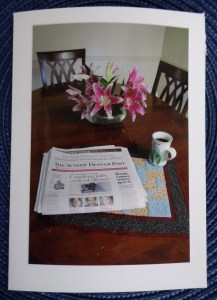 was there at the party last night and brought the best handmade card ever – a photo of her dining room table with a cup of coffee, beautiful flowers (I imagine from her own garden) and a copy of the Sunday Denver Post on the cover – and these words inside: “Retirement … when every day is Saturday, except Sunday, when the big paper comes.” Oh, I adore the way Barb savors life and that retirement philosophy captures her essence perfectly. She went on to encourage me specifically in my future relationships, activities and interests and ended by thanking me for the grace that I had offered in her imperfections (all only imagined, I’m sure!).
Even now Barb continues to be my mentor and my role model. I’d be proud to one day grow up to be a retired person just like her. I feel fortunate and honored to have shared a piece of my path with her for so many years and to carry her influence with me as I discover what lies ahead. And yes, my friend, I will always be happy to stay in touch with you – you have been, are, and will continue to be a rich gift of Grace and Goodness!
 womensharinggrace